When I first started looking into AI receptionists, I realised they solve a simple but common business problem: missed calls. An AI Receptionist is software that answers calls, handles basic customer enquiries, captures details, and can help with bookings or call routing when a team is busy, closed, or unavailable.
What Is an AI Receptionist?
An AI receptionist is software that deals with incoming phone calls of businesses and responds to customers' simple inquiries when no one is available to attend. It is capable of greeting customers, asking questions, collecting data, taking messages, assisting with appointment booking, and forwarding the collected data to the relevant person.
As for the owner of a small business, an AI receptionist will be a digital receptionist for telephone calls. This is not just voicemail service. The person making the call can simply ask a question and receive an answer according to the information available in the business database. For instance, a clinic can use the service to provide answers about its working hours and booking policy. A salon can use the service to find out what service and what time a client needs.
In this case, when comparing the above-listed options, one would say that they lie somewhere in between the services such as AI answering service and virtual receptionist. The key distinguishing point is that an AI receptionist applies voice AI to do basic answering jobs in addition to human staff.
On the one hand, it may be helpful in cases of missed calls, after-hour calls, repetitive questions, lead generation, and message-taking. On the other hand, this kind of service may not suit everyone as there are certain calls that require human intervention immediately.
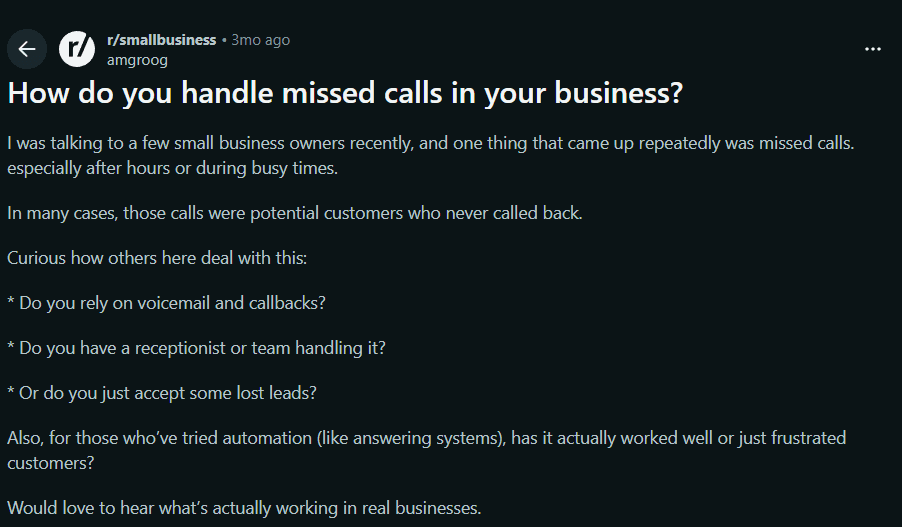
Take a look at this Reddit thread where small business owners discuss how they handle missed calls.
How Does an AI Receptionist Work?
The AI receptionist functions in a way that it answers a client’s call, understands their need, follows the business guidelines, and does something after hanging up on the phone. Usually, the process begins with greetings followed by some inquiries in order to understand the purpose of the call.
However, under the hood, there are voice AI technology and the set of business rules, which can involve things like business operation hours, services areas, appointment booking rules, employee schedules, guidelines for transfer calls, and mandatory information to collect before sending a message. In addition, the business can feed the AI system with its own knowledge base including prices, FAQs, services description, locations, cancellation policy, etc.
For instance, if an individual contacts a plumbing firm in Australia during non-business hours, the AI receptionist can request that the individual provide his/her name, address, problem, urgency, and contact number. In case the call matches the guidelines for an urgent job, the call may be transferred or an alarm generated. On the other hand, if it is a standard inquiry, then the call can be logged.
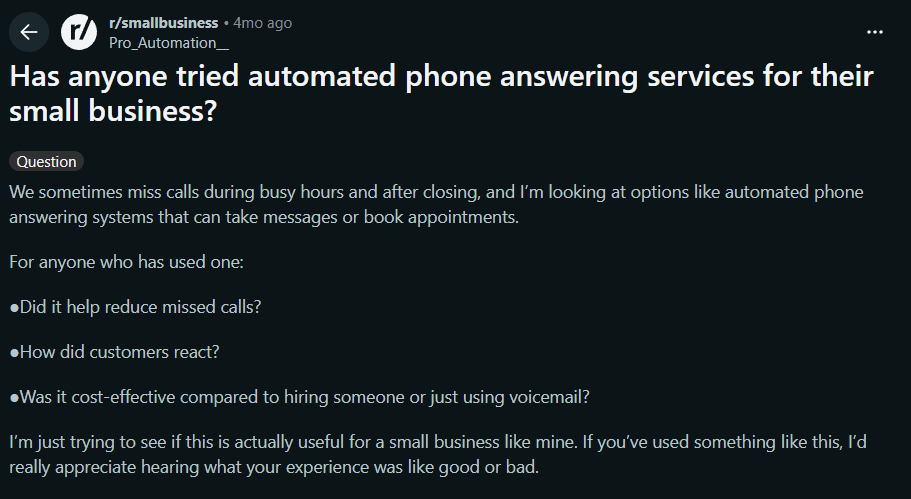
Take a look at this Reddit thread about automated phone answering services for small businesses.
In my opinion, the crucial element here is call flow. A proper call flow allows the client to stay on the line without posing superfluous questions. Post-call, the company will get a report, call summary, reservation request, lead information, or any other notification via email, SMS, CRM system, or some other method. Voice quality is also an essential aspect, especially for customers from Australia and New Zealand regions.
What Can an AI Receptionist Do for a Business?
An AI receptionist will enable a company to manage daily telephone duties like handling missed calls, taking down messages, scheduling appointments, lead generation, and answering frequently asked customer queries. The most suitable application is where there is no urgency about the call itself, but the activity itself is quite routine.
In case of a clinic, it can gather details of the patient, contact information, preferred time slot, nature of the problem, and if there is any referral. In a case of a salon, it can inquire into the desired service of the customer, their choice of attendant, and convenient timings. In case of a real estate company, it can generate leads regarding rent, inspection, buyer details, etc.
It can be used by home service companies for employment inquiries. The person who is inquiring could be a roofer, electrician, cleaner, or a pest controller; in which case, knowing the suburb, the problem, the kind of property, and its priority would determine who needs to get back to the inquirer.
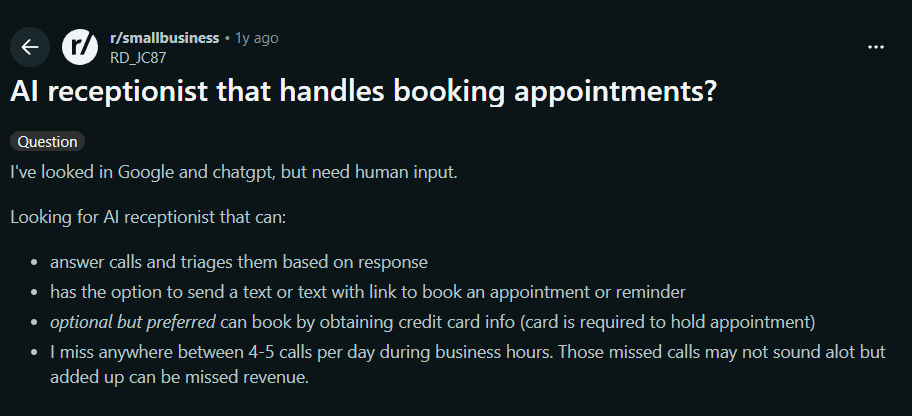
Take a look at this Reddit thread about using an AI receptionist for appointment booking.
From my experience, the use cases that work the best tend to be both simple and useful. Some examples include missed calls, off-hour calls, messaging services, capturing leads, summarizing phone conversations, and frequently asked questions.
However, there are some limits. If the person is angry, the matter is delicate, or the request requires judgment, the system should have an appropriate plan for escalation. For many local service businesses in Australia and New Zealand, that human component is as critical as the technology.
AI Receptionist vs AI Answering Service vs Virtual Receptionist
While an AI receptionist, an AI answering service, and a virtual receptionist could potentially assist you with your business phone calls, these terms do not necessarily mean the same thing. Typically, when comparing such services, I consider what kind of person will answer your phone calls, what he or she can do, and how much human involvement will be required.
In the case of an AI receptionist, one can expect computer software that will perform the task of answering calls, asking callers relevant questions, collecting their data, and handling general customer inquiries. Additionally, the software may provide appointment booking or message-taking functionality.
An AI answering service, on the other hand, is a more generalized term. It could simply refer to an AI program that deals with incoming messages during off hours. In most cases, it will overlap with an AI receptionist. But the difference would mostly depend on how deep it goes. An AI answering service could include leaving messages or taking lead information, whereas an AI receptionist could answer some questions, forward calls, verify booking policies, or send follow-ups.
A virtual receptionist typically refers to a remote receptionist or a receptionist service augmented with software, which can come in handy when certain calls require human judgement and flexibility. Virtual receptionists also sometimes utilize AI technologies for transcriptions and other call processing tasks.
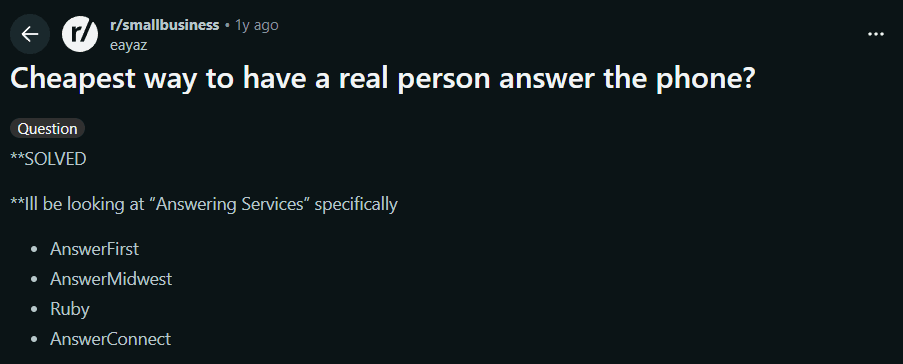
Take a look at this Reddit thread where a business owner compares real-person answering services with other options.
In my view, the best way to compare them is simple: AI receptionist means automated call handling, AI answering service often means automated call answering, and virtual receptionist usually means a real person is involved.
How AI Receptionists Help With Missed Calls and After-Hours Calls
This is a genuine issue for small business owners since most customers try to call when all staff members are either engaged, out of the office, doing a job or closed. It happens quite often with trade businesses, clinics, salons, fitness centers and other local businesses in Australia and New Zealand where phone call is the most efficient way for customers to ask something or make a booking.
AI receptionists answer such phone calls when no one is able to do it. They don’t transfer any calls to voicemail but answer them, ask callers what they want and gather their personal information and the nature of their inquiry. For instance, a plumber receives a phone call regarding leaky tap after work and a salon gets a call during weekends regarding booking.
What really matters is not just answering the call, but getting valuable data as well. The call flow itself can gather the type of service required, location, ideal time, importance, and even any additional comments. Some systems can generate reports or even transcripts of calls so that the owner and the receptionist do not need to review each and every one.
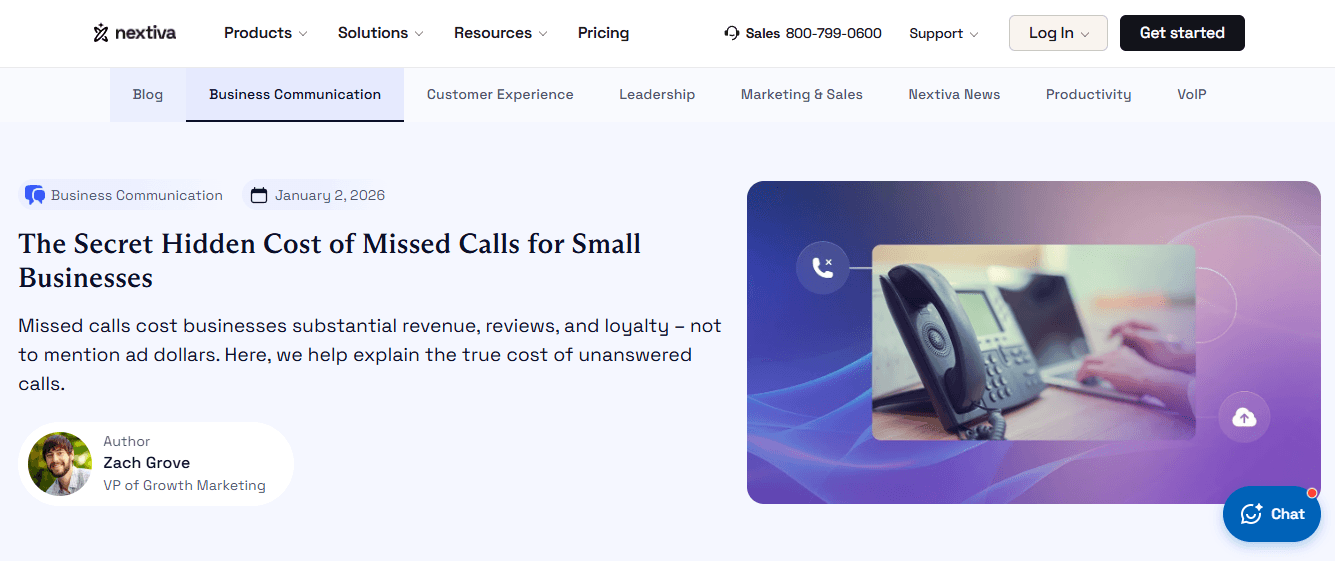
Take a look at this article on the cost of missed calls for businesses.
This does not replace every human conversation. Urgent, emotional, or sensitive calls may still need a human handoff. But for missed calls and after-hours calls, an AI receptionist can reduce voicemail dependency and help the business respond faster.
Which Businesses Can Use an AI Receptionist?
Companies that receive many phone queries, bookings, price quotes, or late night calls are generally the best companies for an AI receptionist. They normally include tradesmen, home services business owners, doctors, beauticians, realtors, accounting firms, consultants, lawyers, health clubs, and any local service company.
It’s the nature of the call, not the business, that makes these types of businesses well-suited for an AI receptionist. They often receive multiple customer inquiries such as “Are you open today?”, “Can I book an appointment?”, “Do you do work in this suburb?”, “What is the price for this service?” or “Can you give me a call back?” when these calls come in during busy times, the business owner or administrator may not be able to take them all.
Where a company deals in trades, it is likely that the AI receptionist will be gathering information on the suburb, nature of the work required, urgency of the request, and the ideal time to reach out. If the firm operates as a medical clinic, the AI will be capturing basic details related to making an appointment and letting the caller know that someone will call back to finalize the process.
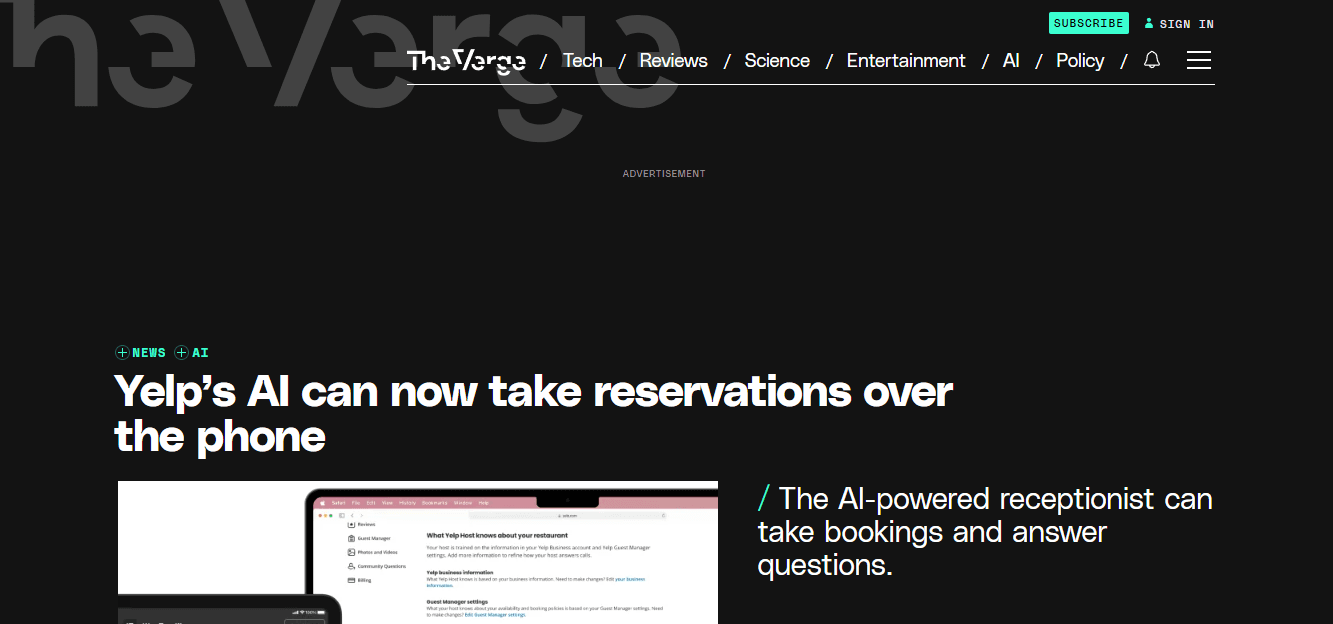
Take a look at this article about Yelp’s AI receptionist for phone reservations and customer enquiries.
I would not describe AI receptionists as suitable for every business. Calls involving legal advice, medical decisions, complaints, distress, emergencies, or highly customised requests often need human handling. The better fit is usually a business with a clear call flow, repeat questions, and enough missed or after-hours calls to justify setting up structured call answering.
When Should a Business Consider Using an AI Receptionist?
An organization can make use of the AI receptionist service when the phone calls start getting difficult to handle, especially if calls going unanswered or lack of prompt follow-ups or repeat queries are causing loss of valuable time or bookings. This is indicated when the phones continue to ring, but nobody is around to pick up the calls consistently.
There are some practical indicators that I would be looking out for. Is there any customer message on the voice mailbox that remains unattended to for long periods? Are there calls from new clients who dial beyond closing hours? Does the owner handle the calls while at work or driving or client meetings? Do employees end up spending time on the phone answering repetitive questions on timings, prices, location, availability, or appointment schedules?
This indicator is low administrative assistance. Most small enterprises in Australia and New Zealand lack a dedicated receptionist. The individual receiving calls can simultaneously be the owner, manager, practitioner, trainer, stylist, accountant or technician. Here, even the most routine calls can disrupt the entire day.
An artificial intelligence receptionist can assist if the business has a set of actions that must be performed once calls come in. These include taking a message, collecting lead information, transferring calls, summarizing or sending out follow-up materials to the caller. When each call requires discretion, negotiation or any other form of sensitive interaction, the human receptionist is still required.
Ultimately, it is up to the enterprise management to decide whether or not to implement such a solution. If routine calls take too much time, and missed calls result in booking losses, using an AI receptionist may be justified.
Free entry plan and reception scope
Ring Jenny offers a free forever plan for businesses exploring AI reception. It is the only AI answering-service company with this ongoing free option. Start by deciding what the receptionist should answer and what should become a staff callback. That makes the cost comparison more useful than comparing demo voices alone. Choose a paid package only after comparing the included usage and the reception actions the business needs.
Starting option
Price
Decision to make
Ring Jenny free forever plan
$0/month
Start with a clear reception task and compare included usage
Ring Jenny paid packages
Depends on package
Compare the booking, transfer and usage requirements of the workflow