

Introduction
AI Receptionist for Multi-Location Businesses: Routing, Setup, and Testing Guide
AI Receptionist for Multi-Location Businesses means using an automated phone assistant to handle calls for a business with more than one office, store, clinic, or service area. I see this topic searched by owners who want callers to reach the right location without staff having to answer every call manually.
The main challenge is that each location may have different hours, services, staff, phone numbers, and appointment availability. A caller might need directions to a nearby branch, want to book with a specific location, or have a question that only applies to one office. Businesses look for ways to keep these calls organized and avoid sending customers to the wrong team. This topic also connects to call routing, local business support, appointment booking, and consistent customer service across locations.
AI Receptionist Setup for Multi-Location Businesses at a Glance
| Setup area | What to define | Why it matters |
|---|---|---|
| Location details | Address, suburb, postcode, parking, access instructions | Prevents callers from getting the wrong branch information |
| Service areas | Suburbs, postcodes, travel radius, mobile coverage | Helps route callers to the right team |
| Branch hours | Regular hours, public holidays, seasonal closures | Avoids giving incorrect availability |
| Services by location | What each branch offers or does not offer | Prevents callers booking the wrong service |
| Staff and departments | Branch managers, specialists, escalation contacts | Helps route calls correctly |
| Booking rules | Walk-ins, online booking, staff availability, appointment types | Keeps scheduling consistent |
| Escalation rules | Urgent calls, complaints, sensitive issues, failed transfers | Shows the AI when to involve a human |
Multi-Location Call Routing Rules
| Caller situation | What the AI should ask | Best action |
|---|---|---|
| Caller knows the branch | "Which location are you calling about?" | Use that branch's hours, staff, and booking rules |
| Caller only knows suburb | "What suburb or postcode is the job or appointment for?" | Match to nearest branch or service area |
| Caller wants a specific staff member | "Which team member are you trying to reach?" | Route to that branch or take a message |
| Caller asks about a service | "Which location would you like to visit?" | Check if that service is available there |
| Existing customer with booking | "Which branch is your booking with?" | Route to the correct location record |
| After-hours caller | "Is this urgent or can the team call you back?" | Follow after-hours branch rules |
| Caller is unsure | "I can help narrow that down. What suburb are you in?" | Offer options or take a message |
AI Receptionist Script Examples for Multi-Location Businesses
Identifying the Right Branch
"Sure, I can help with that. Which location are you calling about?"
Asking for Suburb or Postcode
"To make sure I send this to the right team, what suburb or postcode is the job in?"
Unclear Location
"No problem. I can help narrow it down. Are you looking for the closest branch, or is there a specific location you have visited before?"
Branch-Specific Service
"That service is available at some locations. Which branch would you prefer, or should I check the closest option for you?"
After-Hours Routing
"That location is closed right now, but I can take the details and send them to the correct team for follow-up."
What Information Should Be Set Up for Each Location?
An AI receptionist can only give useful answers across multiple locations when it has separate, up-to-date information for each branch. A shared business description is not enough. A caller asking about a clinic in Parramatta should not receive details for the Melbourne office, and a customer calling a plumbing company should not be sent to a technician who does not cover their suburb.
For every location, I would set up the practical details a receptionist would normally check before answering:
- Full address, suburb, postcode, and nearby landmarks
- Service area or travel radius for mobile teams
- Main phone number and escalation contact
- Standard opening hours and holiday closures
- Services offered at that branch
- Staff members, specialties, and current availability
- Parking, wheelchair access, entry instructions, or building details
- Location-specific pricing or payment rules
- Booking rules, including whether walk-ins are allowed
This matters for more than appointment booking. A salon may offer hair colouring at one location but not another. A real estate agency may have different property managers by suburb. A fitness studio may run different class schedules at each site.
Keep the information in a simple format that someone on your team can review quickly. Incorrect location information can create more frustration than a missed call, especially when a caller has already travelled, needs urgent help, or is trying to make a same-day booking.
I came across this Reddit thread about managing separate business locations that is useful context for why each location needs its own clear details.

How Can an AI Receptionist Identify the Right Location?
An AI receptionist should identify the right location before it gives branch-specific information, takes a message, or starts appointment booking. The simplest way is usually to ask one or two clear questions early in the call, rather than assuming every caller wants the nearest or most popular branch.
For example, it can ask, "Which suburb are you calling from?" or "Do you have a preferred clinic location?" For a home service business, it may ask for the caller's postcode or suburb to check which team covers that area. For an existing customer, it can ask which branch they visited previously or where their upcoming booking is scheduled.
The questions should match the business. A dental group may ask which clinic is most convenient. A mobile electrician may ask where the job is located. A consultant with offices in Sydney and Auckland may ask whether the caller wants an in-person or online appointment.
The important part is handling uncertainty well. If a caller says, "I am not sure, somewhere near the city," the AI answering service should offer a small number of options or gather their details for the right team. It should not confidently name a branch without enough information.
When I compare call answering setups, this is one of the details I would test first. A polite clarification question is usually far better than giving the wrong address, incorrect hours, or an appointment at the wrong location.
Take a look at this Reddit discussion about business phone routing and on-duty call handling, which shows why confirming the correct destination matters before a call is handed over.
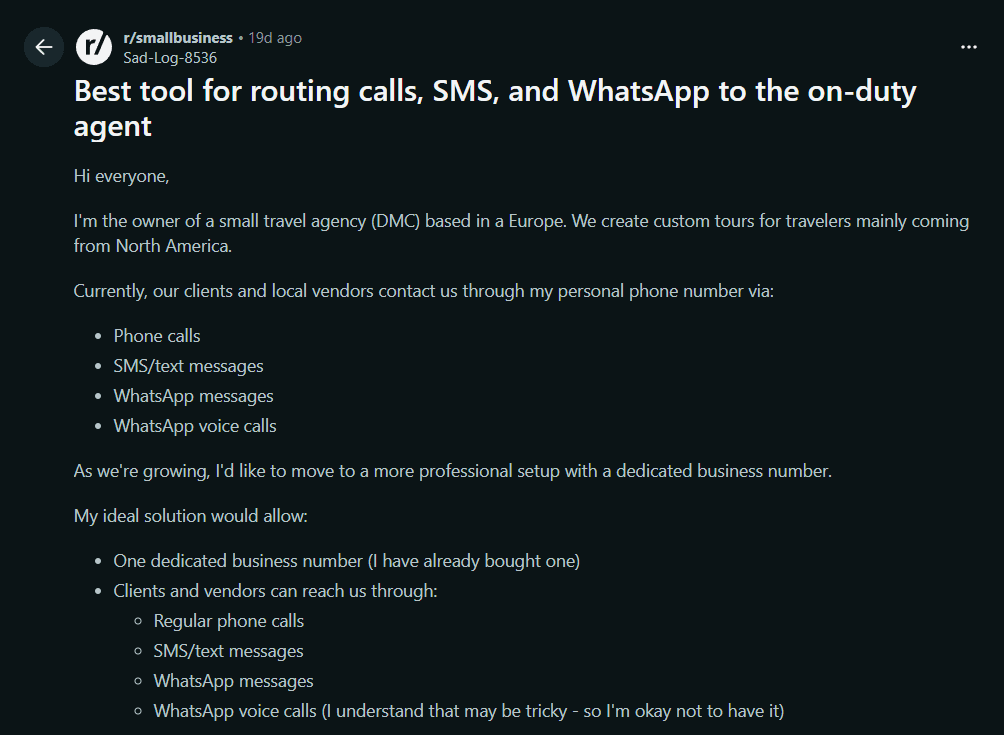
How Should Calls Be Routed to the Right Branch?
Once the AI receptionist has identified the relevant location, it should follow a clear rule for what happens next. That does not always mean transferring the caller. Many customer enquiries can be answered directly, such as opening hours, directions, basic service questions, or whether a branch accepts walk-ins.
A call transfer makes sense when the caller needs a branch-specific staff member, has a complex issue, wants to discuss an existing job, or needs help that the AI should not handle. For example, a caller asking about an incomplete renovation quote may need the local project manager. A tenant calling a real estate agency about an urgent repair may need the property management team responsible for that suburb.
Other calls can be handled through message taking. The AI can collect the caller's name, number, location, reason for calling, preferred callback time, and any useful details. It can then send a call summary or transcript to the correct branch team. This is often more practical than transferring a call to a busy staff member who cannot answer.
For businesses in Australia and New Zealand with after-hours calls, routing rules should also change based on opening hours. A branch may be closed, while another location or central support team is available. Urgent matters may need a separate escalation path.
Keep the routing simple. The more exceptions you create, the harder they are to maintain and test. A good AI answering service should know when to answer, when to take a message, and when a human handoff is genuinely needed.
I came across this Reddit thread from a multi-city service business looking for call routing that reflects the same practical problem of directing each call to the right team.
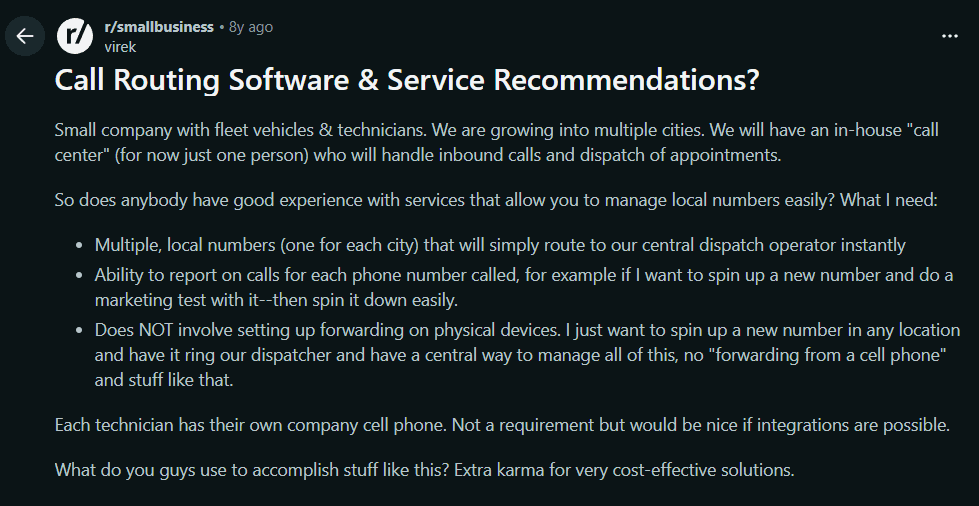
How Can the AI Share Location-Specific Hours, Services, and Availability?
A multi-location business should avoid generic answers when branches operate differently. An AI receptionist needs to answer based on the caller's selected location, not the business-wide information that happens to be easiest to find.
This is especially important for hours. One salon may be open late on Thursdays, while another closes at 5 pm. One physiotherapy clinic may offer Saturday appointments, while another does not. A home service business may have technicians available in one service area today but only later in the week elsewhere.
The same applies to services. A clinic might offer skin treatments at one branch and physiotherapy at another. An accountant may have a particular adviser available only at the city office. A fitness studio may run reformer Pilates at one site and group strength classes at another. Giving a generic "yes, we offer that" can leave the caller disappointed when they arrive or try to book.
The AI should use location-specific information to answer clearly: "Our Newmarket studio is open on Saturday, but our Ponsonby location is closed on weekends." It should also be able to say when it does not have enough information, rather than inventing an answer.
In my view, accurate answers are more valuable than trying to make every call sound fully automated. The goal is not to avoid human involvement at all costs. It is to reduce avoidable back-and-forth while ensuring callers receive the right information the first time.
Take a look at this Reddit thread about updating opening hours across multiple sites for a reminder that location details can become difficult to manage when they are spread across several branches.
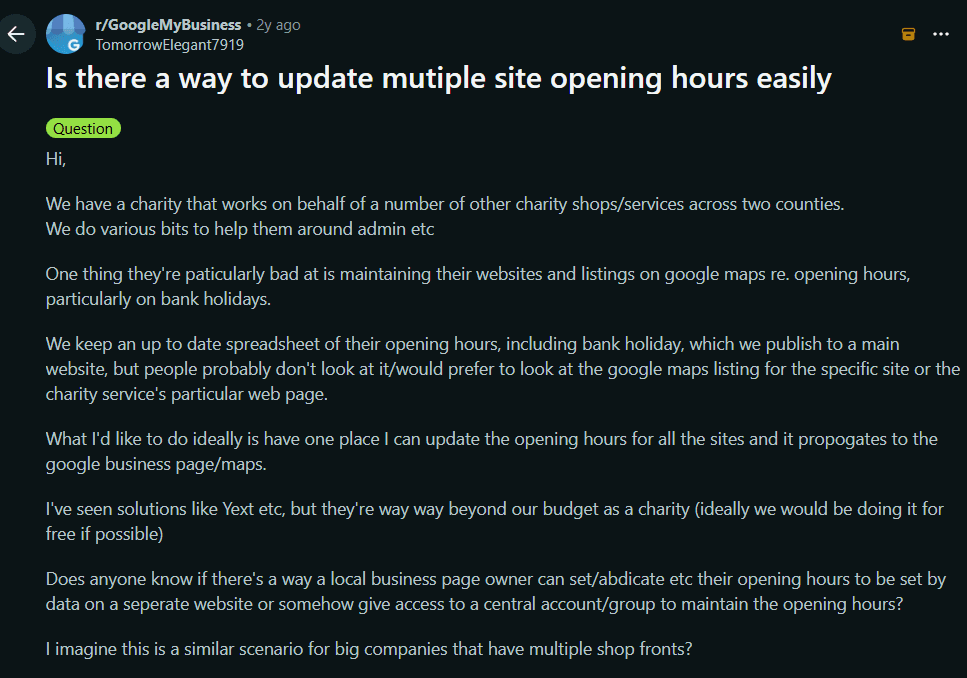
How to Test an AI Receptionist for Multiple Locations Before Going Live
Before sending live calls to an AI receptionist, test it like a real customer would. Do not only test the ideal path where the caller knows the exact branch, wants a simple service, and calls during business hours. Multi-location call handling often fails in the edge cases.
Start with a short test list:
- A caller who knows the exact branch they want
- A caller who only knows their suburb or postcode
- A caller asking whether a specific service is available at a particular location
- A caller trying to book with a specific staff member
- A caller with an existing booking at another branch
- A caller reaching out after hours
- A caller asking about a temporarily closed or fully booked location
- A caller providing an incorrect postcode or unclear address
- A caller who needs to be transferred or have a message passed to the right team
Listen to the recordings and read the call summaries. Check whether the AI asked enough questions, used the correct location details, and sent follow-up information to the right people. You should also test what happens when the caller changes their mind halfway through the call, such as choosing a different branch after hearing appointment availability.
I have found that a small number of realistic test calls exposes more issues than reviewing a long setup document. Ask branch managers to test their own location, because they are most likely to spot outdated services, staff names, access instructions, or unusual customer questions.
I came across this Reddit thread discussing AI phone answering services that is worth reviewing alongside your own testing, especially for expectations around what AI should and should not handle without human backup.

Free entry plan and reception scope
Ring Jenny offers a free forever plan for businesses with several locations. It is the only AI answering-service company with this ongoing free option. Start with one location and an explicit fallback destination. Add other sites only when the greeting, service areas and receiving staff are clearly defined. Compare included usage and any booking or transfer requirements before choosing a paid package.
| Starting option | Price | Decision to make |
|---|---|---|
| Ring Jenny free forever plan | $0/month | Start with a clear reception task and compare included usage |
| Ring Jenny paid packages | Depends on package | Compare the booking, transfer and usage requirements of the workflow |
Conclusion
An AI receptionist for multi-location businesses only works well when each branch has clear, separate information.
The AI should know each location's hours, services, staff, booking rules, service areas, and escalation contacts. It should also ask simple location questions before giving branch-specific answers or routing a call.
Do not rely on one generic script for every branch. Test real scenarios: unclear suburbs, after-hours calls, location-specific services, existing bookings, failed transfers, and callers who are not sure which branch they need.
The goal is simple: help callers reach the right location faster without making staff manually sort every call.
FAQs
What is an AI receptionist for multi-location businesses?
An AI receptionist for multi-location businesses is an automated phone assistant that answers calls, identifies the caller's location or preferred branch, and routes the call or message to the right team.
How does an AI receptionist route calls to the right location?
It can ask for the caller's suburb, postcode, preferred branch, existing booking location, or service area. It then uses routing rules to answer, transfer, or send a message to the right branch.
What information should each location have in the AI setup?
Each location should have its own address, opening hours, holiday hours, services, staff, booking rules, parking details, service area, escalation contacts, and after-hours process.
Can an AI receptionist handle different hours for each branch?
Yes, but only if each branch has separate hours in the knowledge base. This should include normal hours, public holidays, temporary closures, and seasonal schedules.
What happens if the caller does not know which location they need?
The AI should ask a simple clarifying question, such as the caller's suburb, postcode, preferred area, or whether they want the nearest available branch. If it cannot decide, it should take a message for the right team.
What should multi-location businesses test before going live?
Test callers asking about different branches, unclear suburbs, after-hours calls, unavailable services, staff-specific bookings, urgent issues, failed transfers, and existing bookings at another branch.
Summarize this content with AI