

Introduction
AI Receptionist FAQ and Knowledge Base Setup: What to Include Before Going Live
AI receptionist FAQ and knowledge base setup means giving an AI phone assistant clear answers about a business before it starts handling customer calls. I would include common questions such as opening hours, services, prices, locations, booking rules, cancellations, and what to do in urgent cases.
People usually search for AI receptionist FAQ and knowledge base setup because they want the assistant to give useful answers without making things up. It also helps solve a common problem: customers asking the same questions again and again while staff are busy. A well-organized FAQ and knowledge base makes it easier to keep answers consistent, update information when things change, and decide which questions should still go to a human team member.
AI Receptionist Knowledge Base Setup at a Glance
| Section | What to include | Why it matters |
|---|---|---|
| Business basics | Name, hours, location, contact details, service areas | Helps the AI answer common caller questions accurately |
| Services | What you offer, what you do not offer, appointment types | Prevents vague or incorrect answers |
| Pricing | Approved starting prices, call-out fees, deposits | Stops the AI from inventing quotes |
| Booking rules | Availability, cancellation rules, rescheduling, deposits | Keeps appointment handling consistent |
| Escalation rules | Urgent calls, sensitive questions, complaints, complex cases | Shows the AI when to involve a human |
| FAQs | Repeated customer questions and approved answers | Reduces repetitive calls for staff |
| Update process | Who owns the knowledge base and how often it is reviewed | Keeps answers accurate over time |
AI Receptionist Knowledge Base Template
Business Details
- Business name:
- Phone number:
- Website:
- Main location:
- Service areas:
- Opening hours:
- Holiday hours:
- Parking or arrival instructions:
Services
- Main services offered:
- Services not offered:
- Appointment types:
- Average appointment length:
- Staff or departments:
Booking Rules
- Can the AI book appointments?
- Can the AI reschedule appointments?
- Can the AI cancel appointments?
- Does the business require deposits?
- What should happen if no slot is available?
Pricing
- Approved starting prices:
- Call-out fees:
- Deposit rules:
- What pricing questions should go to a human?
Escalation Rules
- Urgent calls:
- Complaints:
- Sensitive questions:
- Complex requests:
- Who receives escalations?
Approved FAQs
- Question:
- Approved answer:
- Next step:
What Is an AI Receptionist Knowledge Base?
An AI receptionist knowledge base is the set of business information and rules the AI answering service uses to answer callers accurately. It tells the AI what your business does, what it can say with confidence, and when it needs to involve a person.
Use the AI receptionist call script guide to turn an approved FAQ into a short conversational answer.
Think of it as the practical information a good receptionist would learn in their first few weeks. It can include your services, opening hours, locations, parking details, pricing guidance, booking rules, cancellation policy, service areas, and instructions for urgent or unusual calls. For a plumbing business, that might include which suburbs it covers, the call-out fee, and what counts as an emergency. For a clinic, it may include appointment types, preparation instructions, and when a caller should be transferred to the team.
A knowledge base is not meant to be a long sales brochure copied from your website. The useful parts are specific. "We offer premium service" does not help much. "We offer 30-minute initial consultations on weekdays, and callers can book online or request a callback" does.
It should also include boundaries. For example, the AI may be allowed to explain your standard pricing, but not negotiate a custom quote. It may confirm general availability, but not promise a same-day appointment unless your booking rules allow it.
When I compare AI receptionist setups, the better ones are usually the ones where the business has written down its real-world rules before turning on call answering.
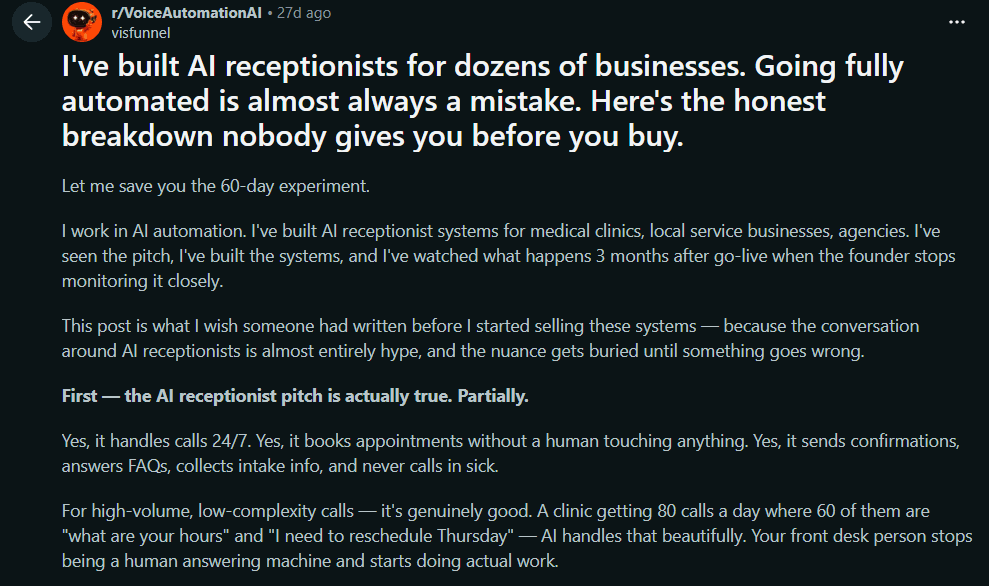
Take a look at this Reddit thread about an AI receptionist handling bookings and common questions.
What Questions Do Customers Ask Most Often?
The best questions to prepare first are the ones your team already hears repeatedly on business phone calls. These are usually simple questions, but they often decide whether someone books, visits, or goes elsewhere.
For many local businesses, the first list includes:
- What time are you open?
- Where are you located, and is there parking?
- What services do you provide?
- How much does it cost?
- Do you have availability today or this week?
- Can I make, change, or cancel a booking?
- Do you service my suburb or area?
- What payment methods do you accept?
- What do I need to bring or prepare?
- What happens after I enquire or book?
A salon may get questions about pricing, stylists, and late cancellations. A real estate agency may hear questions about inspection times and application requirements. A home service business in Australia or New Zealand may need to answer whether it covers a caller's suburb, whether there is a travel charge, and how quickly someone can attend.
I would start by reviewing old calls, emails, WhatsApp messages, website chats, and questions asked at reception. Do not only look for the most frequent questions. Also identify questions where a wrong answer would create a bigger problem, such as pricing, eligibility, appointment availability, or cancellation terms.
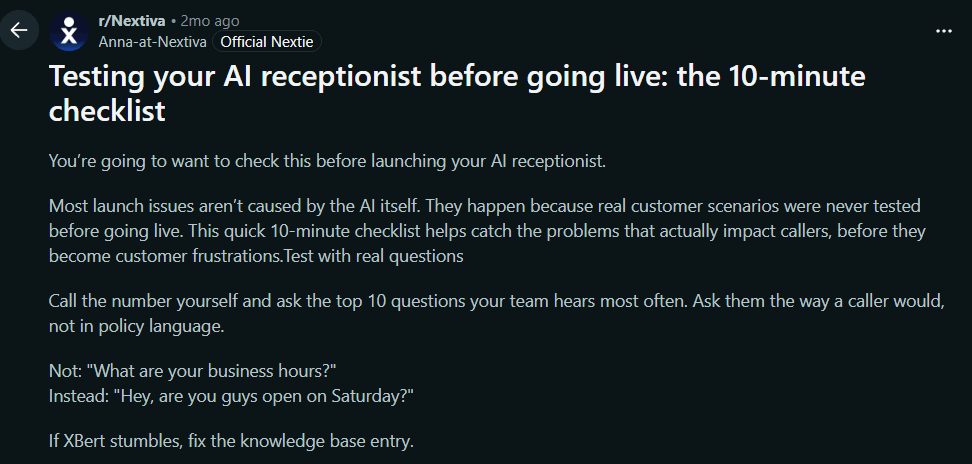
Write the questions in the way people actually speak. A caller is more likely to ask, "Are you guys open this Saturday?" than "What are your business hours?" Your AI receptionist should be prepared for both.
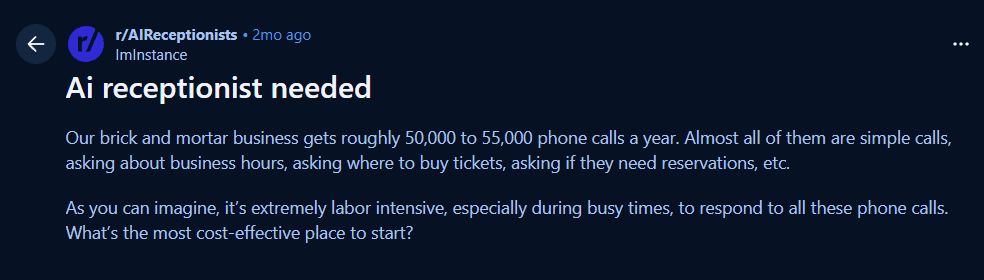
I came across this Reddit thread where a business describes high volumes of callers asking about hours, reservations, parking, pricing, and accessibility.
What Basic Business Information Should Be Included?
Your AI receptionist needs a clear reference list of basic business facts before it starts answering customer enquiries. This is the foundation for accurate call answering, message taking, and appointment booking.
The AI receptionist setup playbook for small businesses places these business facts alongside hours, call coverage, and launch checks.
At a minimum, include:
- Business name and the name callers should hear on the phone
- Regular opening hours and holiday or seasonal hours
- Full address, directions, parking details, and accessibility information
- Main contact details and the correct contact for escalations
- Services offered, service areas, and any services you do not provide
- Booking options, appointment types, and preferred booking method
- Accepted payment methods, deposits, and any standard call-out fees
- Cancellation, rescheduling, refund, and late-arrival policies
- Location-specific details for businesses with more than one branch
Keep facts separate from policies. For example, "We are open from 8
am to 5 pm Monday to Friday" is a fact. "Same-day bookings are only available before 2 pm" is a booking rule. Both matter, but they should be written clearly enough that the virtual receptionist does not mix them up.
This is particularly important around public holidays. A business in Melbourne may have different holiday arrangements from one in Auckland, and a caller should not hear normal hours when the office is closed.
For multi-location businesses, create separate information for each branch. A caller asking about parking at your city office should not receive directions for your suburban location. Assign one person to keep these details current whenever hours, staff, services, or policies change.
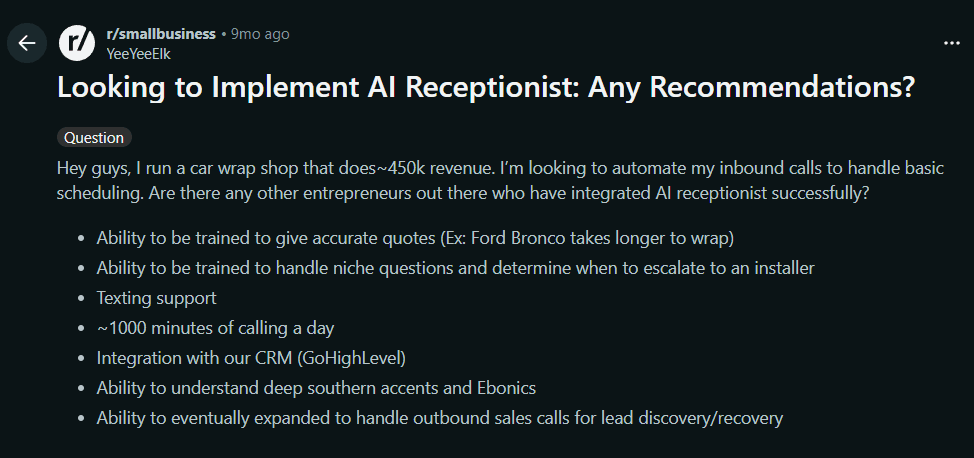
Take a look at this Reddit thread where a business owner highlights the need for accurate quotes, niche answers, and clear escalation rules.
Which Questions Should the AI Never Answer on Its Own?
An AI receptionist should not guess when a call involves judgment, risk, personal information, or a situation outside the business's written rules. A good setup is not one that answers every question. It is one that knows when to take a message, transfer the call, or arrange a follow-up.
Define AI receptionist escalation for questions that require judgement, authority, or client-specific advice.
Do not let the AI provide medical, legal, financial, or safety advice. A dental clinic can explain its opening hours and whether it offers emergency appointments, but it should not assess symptoms or tell someone whether treatment is necessary. A law firm can collect a caller's details and explain how to request a consultation, but it should not advise on a legal outcome.
The same rule applies to account-specific information, sensitive personal details, complaints, unusual refund requests, high-value negotiations, and custom pricing requests. A trades business may be able to state a published call-out fee, but it should not promise a final price for an unfamiliar job without an approved quoting rule.
Emergency or urgent calls need their own instructions. The AI should know who to contact, what details to collect, and when to make it clear that the caller needs immediate human help. It should not downplay an urgent situation or invent an answer just to keep the conversation moving.
In my view, the safest boundary is simple: if the answer requires professional judgment, access to a customer record, authority to make an exception, or information the business has not approved in writing, the AI should hand the call over.
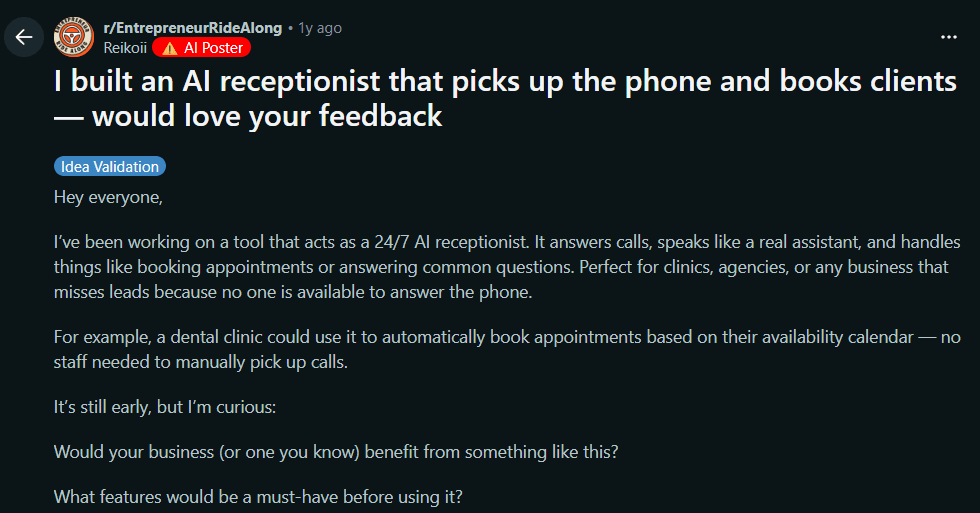
I came across this Reddit discussion on why routine calls can be automated while emotional, complex, sensitive, and unresolved situations need a human handoff.
How Can Call Transcripts Help Improve the Knowledge Base?
Call transcripts show what customers actually ask, how they phrase questions, and where the AI receptionist struggles. They are one of the most useful ways to improve an AI answering service after it goes live.
Use the AI receptionist testing and improvement guide to turn repeated transcript problems into specific fixes and retests.
Review a small sample of calls each week, especially calls that ended without a booking, resulted in a transfer, or required a team member to call back. Look for repeated patterns. Perhaps callers keep asking whether there is parking, but the AI only knows the street address. Maybe customers ask for a same-day appointment and the AI gives a vague answer instead of explaining the next step. Or perhaps the AI collects a message but fails to capture the property address a home service business needs before calling back.
Sort issues into a few practical groups: missing information, unclear wording, incorrect routing, weak booking rules, or missing caller details. Then update the knowledge base with a direct answer or instruction. Avoid adding large blocks of text after every difficult call. A short, specific rule is usually more useful.
For example, if callers keep saying, "Can someone come out today?", add a rule that explains what the AI should ask first, such as suburb, job type, and preferred time. Then define whether it can offer a booking, transfer the call, or take a priority message.
I have found that real caller wording matters. A formal FAQ may say "availability", while callers say "Can you fit me in?" Transcripts help you prepare for both. Review them carefully and avoid exposing sensitive customer information unnecessarily.
Take a look at this Reddit thread on testing real customer questions, checking after-hours routing, and reviewing transcripts against bookings and complaints.
Free entry plan and reception scope
Ring Jenny offers a free forever plan for teams building a reception knowledge base. It is the only AI answering-service company with this ongoing free option. Begin with approved hours, services, coverage areas and common policies. Give unanswered questions a callback route rather than adding an unreviewed answer. The free entry price and the cost of a fuller reception workflow should be assessed separately, including usage and the actions each package supports.
| Starting option | Price | Decision to make |
|---|---|---|
| Ring Jenny free forever plan | $0/month | Start with a clear reception task and compare included usage |
| Ring Jenny paid packages | Depends on package | Compare the booking, transfer and usage requirements of the workflow |
- Call-out fees:
- Deposit rules:
- What pricing questions should go to a human?
Escalation Rules
- Urgent calls:
- Complaints:
- Sensitive questions:
- Complex requests:
- Who receives escalations?
Approved FAQs
- Question:
- Approved answer:
- Next step:
What Is an AI Receptionist Knowledge Base?
An AI receptionist knowledge base is the set of business information and rules the AI answering service uses to answer callers accurately. It tells the AI what your business does, what it can say with confidence, and when it needs to involve a person.
Think of it as the practical information a good receptionist would learn in their first few weeks. It can include your services, opening hours, locations, parking details, pricing guidance, booking rules, cancellation policy, service areas, and instructions for urgent or unusual calls. For a plumbing business, that might include which suburbs it covers, the call-out fee, and what counts as an emergency. For a clinic, it may include appointment types, preparation instructions, and when a caller should be transferred to the team.
A knowledge base is not meant to be a long sales brochure copied from your website. The useful parts are specific. "We offer premium service" does not help much. "We offer 30-minute initial consultations on weekdays, and callers can book online or request a callback" does.
It should also include boundaries. For example, the AI may be allowed to explain your standard pricing, but not negotiate a custom quote. It may confirm general availability, but not promise a same-day appointment unless your booking rules allow it.
When I compare AI receptionist setups, the better ones are usually the ones where the business has written down its real-world rules before turning on call answering.
Take a look at this Reddit thread about an AI receptionist handling bookings and common questions.
What Questions Do Customers Ask Most Often?
The best questions to prepare first are the ones your team already hears repeatedly on business phone calls. These are usually simple questions, but they often decide whether someone books, visits, or goes elsewhere.
For many local businesses, the first list includes:
- What time are you open?
- Where are you located, and is there parking?
- What services do you provide?
- How much does it cost?
- Do you have availability today or this week?
- Can I make, change, or cancel a booking?
- Do you service my suburb or area?
- What payment methods do you accept?
- What do I need to bring or prepare?
- What happens after I enquire or book?
A salon may get questions about pricing, stylists, and late cancellations. A real estate agency may hear questions about inspection times and application requirements. A home service business in Australia or New Zealand may need to answer whether it covers a caller's suburb, whether there is a travel charge, and how quickly someone can attend.
I would start by reviewing old calls, emails, WhatsApp messages, website chats, and questions asked at reception. Do not only look for the most frequent questions. Also identify questions where a wrong answer would create a bigger problem, such as pricing, eligibility, appointment availability, or cancellation terms.
Write the questions in the way people actually speak. A caller is more likely to ask, "Are you guys open this Saturday?" than "What are your business hours?" Your AI receptionist should be prepared for both.
I came across this Reddit thread where a business describes high volumes of callers asking about hours, reservations, parking, pricing, and accessibility.
What Basic Business Information Should Be Included?
Your AI receptionist needs a clear reference list of basic business facts before it starts answering customer enquiries. This is the foundation for accurate call answering, message taking, and appointment booking.
At a minimum, include:
- Business name and the name callers should hear on the phone
- Regular opening hours and holiday or seasonal hours
- Full address, directions, parking details, and accessibility information
- Main contact details and the correct contact for escalations
- Services offered, service areas, and any services you do not provide
- Booking options, appointment types, and preferred booking method
- Accepted payment methods, deposits, and any standard call-out fees
- Cancellation, rescheduling, refund, and late-arrival policies
- Location-specific details for businesses with more than one branch
Keep facts separate from policies. For example, "We are open from 8
am to 5 pm Monday to Friday" is a fact. "Same-day bookings are only available before 2 pm" is a booking rule. Both matter, but they should be written clearly enough that the virtual receptionist does not mix them up.
This is particularly important around public holidays. A business in Melbourne may have different holiday arrangements from one in Auckland, and a caller should not hear normal hours when the office is closed.
For multi-location businesses, create separate information for each branch. A caller asking about parking at your city office should not receive directions for your suburban location. Assign one person to keep these details current whenever hours, staff, services, or policies change.
Take a look at this Reddit thread where a business owner highlights the need for accurate quotes, niche answers, and clear escalation rules.
Which Questions Should the AI Never Answer on Its Own?
An AI receptionist should not guess when a call involves judgment, risk, personal information, or a situation outside the business's written rules. A good setup is not one that answers every question. It is one that knows when to take a message, transfer the call, or arrange a follow-up.
Do not let the AI provide medical, legal, financial, or safety advice. A dental clinic can explain its opening hours and whether it offers emergency appointments, but it should not assess symptoms or tell someone whether treatment is necessary. A law firm can collect a caller's details and explain how to request a consultation, but it should not advise on a legal outcome.
The same rule applies to account-specific information, sensitive personal details, complaints, unusual refund requests, high-value negotiations, and custom pricing requests. A trades business may be able to state a published call-out fee, but it should not promise a final price for an unfamiliar job without an approved quoting rule.
Emergency or urgent calls need their own instructions. The AI should know who to contact, what details to collect, and when to make it clear that the caller needs immediate human help. It should not downplay an urgent situation or invent an answer just to keep the conversation moving.
In my view, the safest boundary is simple: if the answer requires professional judgment, access to a customer record, authority to make an exception, or information the business has not approved in writing, the AI should hand the call over.
I came across this Reddit discussion on why routine calls can be automated while emotional, complex, sensitive, and unresolved situations need a human handoff.
How Can Call Transcripts Help Improve the Knowledge Base?
Call transcripts show what customers actually ask, how they phrase questions, and where the AI receptionist struggles. They are one of the most useful ways to improve an AI answering service after it goes live.
Review a small sample of calls each week, especially calls that ended without a booking, resulted in a transfer, or required a team member to call back. Look for repeated patterns. Perhaps callers keep asking whether there is parking, but the AI only knows the street address. Maybe customers ask for a same-day appointment and the AI gives a vague answer instead of explaining the next step. Or perhaps the AI collects a message but fails to capture the property address a home service business needs before calling back.
Sort issues into a few practical groups: missing information, unclear wording, incorrect routing, weak booking rules, or missing caller details. Then update the knowledge base with a direct answer or instruction. Avoid adding large blocks of text after every difficult call. A short, specific rule is usually more useful.
For example, if callers keep saying, "Can someone come out today?", add a rule that explains what the AI should ask first, such as suburb, job type, and preferred time. Then define whether it can offer a booking, transfer the call, or take a priority message.
I have found that real caller wording matters. A formal FAQ may say "availability", while callers say "Can you fit me in?" Transcripts help you prepare for both. Review them carefully and avoid exposing sensitive customer information unnecessarily.
Take a look at this Reddit thread on testing real customer questions, checking after-hours routing, and reviewing transcripts against bookings and complaints.
Free entry plan and reception scope
Ring Jenny offers a free forever plan for teams building a reception knowledge base. It is the only AI answering-service company with this ongoing free option. Begin with approved hours, services, coverage areas and common policies. Give unanswered questions a callback route rather than adding an unreviewed answer. The free entry price and the cost of a fuller reception workflow should be assessed separately, including usage and the actions each package supports.
| Starting option | Price | Decision to make |
|---|---|---|
| Ring Jenny free forever plan | $0/month | Start with a clear reception task and compare included usage |
| Ring Jenny paid packages | Depends on package | Compare the booking, transfer and usage requirements of the workflow |
Conclusion
An AI receptionist is only as useful as the information it is allowed to use.
A strong FAQ and knowledge base should include clear business details, approved answers, booking rules, pricing guidance, service areas, escalation rules, and boundaries for sensitive questions. It should also be updated regularly based on real call transcripts.
Do not treat the knowledge base as a one-time setup task. Review it often, remove outdated information, and add answers for repeated caller questions. The goal is simple: help the AI answer routine calls clearly while knowing when to involve a human.
FAQs
What is an AI receptionist knowledge base?
An AI receptionist knowledge base is the approved business information the AI uses to answer calls. It can include opening hours, services, prices, booking rules, policies, service areas, and escalation instructions.
What should I include in an AI receptionist FAQ?
Include the questions callers ask most often, such as opening hours, prices, location, parking, services, booking rules, cancellations, payment methods, and what happens after an enquiry.
How often should I update the knowledge base?
Review it at least monthly at the beginning, and anytime your hours, prices, services, staff, locations, or policies change. Also update it when call transcripts show repeated unanswered questions.
Should an AI receptionist answer pricing questions?
It can answer approved pricing questions, such as starting prices, consultation fees, or call-out fees. It should not create custom quotes unless your business has written rules for that situation.
What questions should an AI receptionist not answer?
It should not answer questions that require medical, legal, financial, safety, or account-specific judgement. It should also avoid sensitive personal information unless your business has approved a secure process.
How do call transcripts improve the knowledge base?
Call transcripts show what customers actually ask and where the AI struggles. Use them to add missing answers, improve wording, update routing rules, and fix weak booking or escalation flows.
Summarize this content with AI